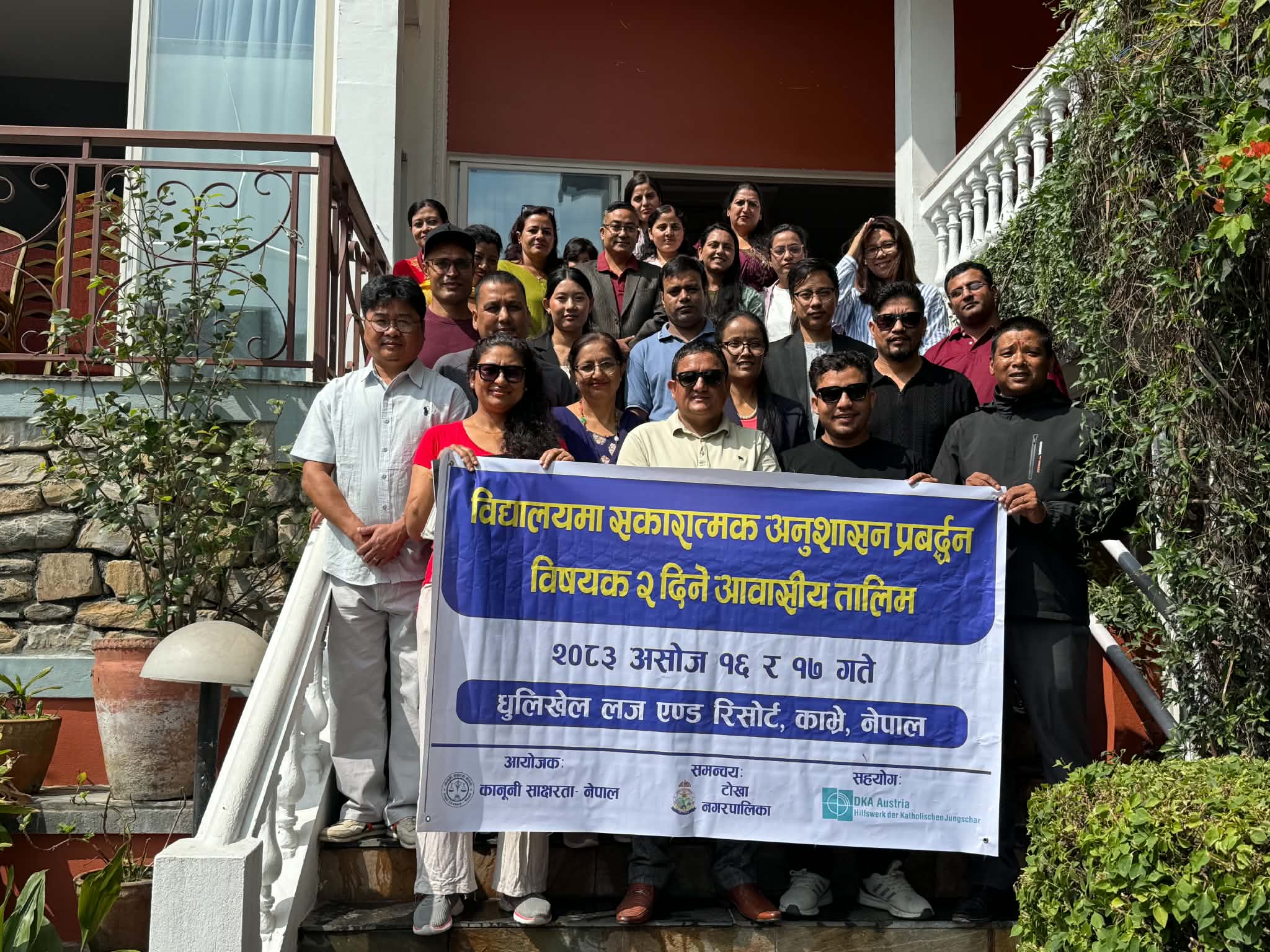
LLN Conducts Two-Day Training on Promoting Positive Discipline in Schools
Legal Literacy – Nepal (LLN) organized a two-day training on “Promoting Positive Discipline in Schools” for 26 participants including teachers representing eight community schools of Tokha Municipality on 2 and 3 October 2026 in Dhulikhel, Kavre.
The training aimed to strengthen teachers’ understanding and practice of positive, child-friendly, non-violent, and participatory approaches to classroom management, while addressing the continued use of corporal punishment in schools despite its legal prohibition in Nepal.
The training was inaugurated by Mr. Om Prakash Sen Thakuri, Executive Director of LLN, who introduced LLN’s mission, vision, and ongoing initiatives to promote child rights and protection in schools. He highlighted LLN’s work on positive discipline, non-violent teaching practices, psychosocial counselling, stress management, and wellbeing.
In his remarks, Mr. Thakuri emphasized that corporal punishment is prohibited under Nepal’s Children Act 2075, yet it continues to affect a significant proportion of schoolchildren. Drawing on LLN’s research, he noted that social acceptance of corporal punishment, institutional weaknesses, and the absence of effective and safe complaint and reporting mechanisms contribute to its continued practice. He stressed that sustainable change requires creating safe, engaging, and supportive learning environments where children can learn without fear of punishment.
The training was facilitated by Mr. Shree Krishna Wenju through an interactive and participatory approach. On the first day, participants took part in activities including a “clock introduction” exercise, group discussions, reflection sessions, and presentations. These activities encouraged teachers to reflect on the qualities they want to nurture in children, factors that contribute to children’s happiness and wellbeing, and the physical and psychological effects of corporal punishment.
The second day focused on practical and classroom-based approaches to positive discipline. Through games and hands-on activities—including a ball-and-bucket game, paper-folding exercises, and teaching through singing activities—participants experienced how engaging and creative teaching methods can improve children’s concentration, encourage curiosity and questioning, and make learning more enjoyable without relying on punishment.
Discussions on positive discipline further emphasized the importance of love, trust, empathy, communication, and understanding the underlying reasons for children’s behaviour. Participants explored how teachers can respond to challenging behaviour constructively rather than relying on fear or physical punishment.
The training concluded with participants sharing their reflections, learning experiences, and commitments to applying positive discipline approaches in their classrooms. Representatives of Tokha Municipality and participating schools also shared closing remarks and encouraged teachers to promote safer and more child-friendly learning environments.
LLN expressed its appreciation to all participating teachers, school representatives, Tokha Municipality, and the facilitator for their active engagement and contributions. The organization reaffirmed its commitment to working with schools and local authorities to eliminate corporal punishment and promote positive, respectful, and child-friendly education.
The training was supported by DKA Austria.